
How to Reduce Glare and Eye Strain When Driving at Night



Photo by Egor Kamelev
If oncoming headlights feel more punishing than they used to, you’re not imagining it. Night driving has gotten genuinely harder over the past decade, and the reasons are a mix of what’s on the road and what’s happening in your eyes.
Here’s what’s actually causing the problem, what helps, and what’s mostly marketing.
Why Night Driving Got Harder
The headlights changed. LED and HID headlights have largely replaced halogen bulbs. They’re brighter, fit in smaller housings that concentrate light into a more intense point source, and skew toward the blue end of the spectrum—which scatters more inside the eye than warmer light does. Add the rise of taller SUVs and trucks, whose headlights sit closer to eye level for anyone in a sedan, and oncoming glare has meaningfully increased.
Your eyes changed too. Pupils shrink with age and dilate more slowly, so less light reaches the retina, and your eyes take longer to recover after a bright car passes. This starts earlier than most people expect—often in your 40s—and progresses gradually enough that you may not notice until you find yourself avoiding night drives.
Both things are happening at once, which is why the problem can feel like it appeared suddenly.
Which Problem Do You Actually Have?
“Trouble seeing at night” covers three different problems, and they don’t have the same fix.
- Glare and starbursts. Lights have spikes, halos, or streaks radiating out from them. This usually points to uncorrected astigmatism, a scratched or dirty lens surface, or early cataracts.
- Not enough detail. The road is dark, and you can’t resolve signs, lane markings, or pedestrians. This is typically a prescription or lighting issue, and tinted lenses make it worse, not better.
- Slow recovery. You’re fine until a car passes, then you’re briefly blind. This is a pupil adaptation issue and is strongly age-related.
Most people have some mix, but usually one dominates. Knowing which one you’re dealing with tells you what to do next.
Photo by Burak The Weekender
Do Yellow-Tinted Night Driving Glasses Work?
Honest answer: the evidence is mixed, and it depends on what you’re asking them to do.
The case for them. Yellow and amber tints filter short-wavelength blue light, which scatters more inside the eye than longer wavelengths. Less scatter can mean less perceived glare and better subjective contrast. Many drivers genuinely find them more comfortable, and comfort isn’t nothing — a less stressful drive is a less fatiguing one.
The case against. A 2019 study published in JAMA Ophthalmology tested this directly. Researchers at the Schepens Eye Research Institute at Mass Eye and Ear put 22 participants through scripted night-driving scenarios in a simulator, three times with three different commercially available yellow-lens glasses and once with clear lenses, with and without simulated oncoming headlight glare. Lens color didn’t affect how quickly participants spotted a pedestrian, and the yellow lenses didn’t reduce the effect of headlight glare either. The authors concluded there was no evidence to support recommending them.
Notably, participants reported that things looked brighter through the yellow lenses—which is exactly the disconnect worth understanding. The mechanism is straightforward: any tint reduces the total light reaching your eye, and at night you need all of it.
Worth noting the study’s limits: 22 participants is a small sample, all had normal visual acuity, and a simulator isn’t a real road. It’s the best evidence available on this question, not the final word.
The distinction that matters. Feeling more comfortable and detecting a hazard sooner are two different outcomes. Tints may deliver the first. The research doesn’t show them delivering the second. If you buy a pair, buy them for comfort, not because you believe they’ll help you spot something in the road.
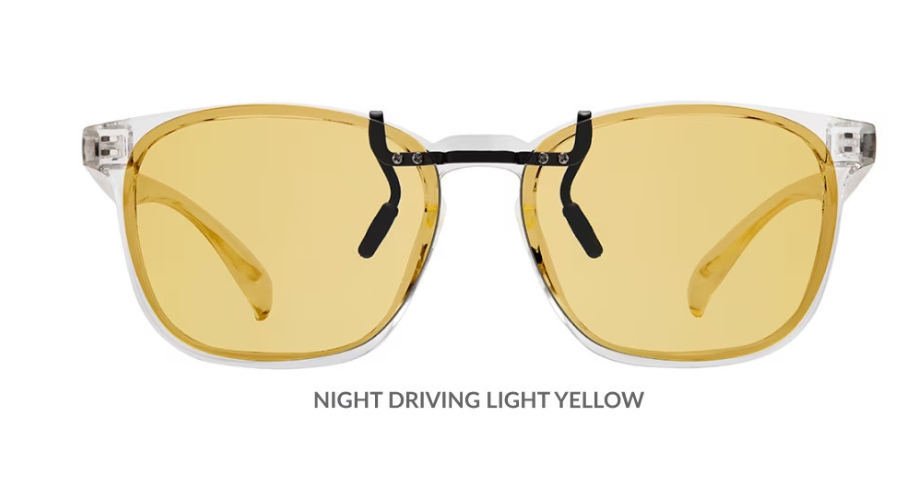
Where Zenni’s options fit. Zenni sells two. The Night Driving Clip-Ons use a light yellow tint and attach to glasses you already own—the on-demand option. The night driving lenses use Mitsui’s NeoContrast™ technology, which is a different approach: rather than a broad tint, it selectively filters narrow wavelength bands—roughly 15% of yellow light near 585nm, blue light below 460nm, and the 390–430nm range where LED headlights put out much of their energy. The result is nearly clear rather than obviously yellow, so it transmits more total light than a conventional tint. Both are available with or without a prescription.¹
¹Improved visual response, glare reduction, and sharper vision claims for Mitsui NeoContrast™ lenses are based solely on manufacturer-conducted research.
Start With Your Prescription
If you take one thing from this article, remember that the most common fixable cause of poor night vision is an out-of-date prescription.
Your pupils dilate in the dark, which means light enters through a wider portion of your cornea and lens. Small refractive errors that your eye compensates for in daylight stop being compensated for at night. Uncorrected astigmatism is the biggest offender—it’s why headlights turn into starbursts and streetlights grow spikes. Plenty of people who’ve never worn glasses discover they need a mild correction specifically for driving after dark.
Then add anti-reflective coating. This is the lens feature with the strongest evidence behind it. AR coating reduces reflections bouncing off the lens surfaces—the ghost images and halos a bare lens creates from every headlight and streetlight. Unlike a tint, it doesn’t reduce the amount of light reaching your eye. It lets through close to all available light while cutting the reflections that scatter it.
Worth knowing: AR coating only helps if you’re wearing corrective lenses. There’s no benefit to non-prescription clear lenses with AR—the coating is fixing a problem the lens itself introduced.
If it’s been more than a year or two, book an eye exam and mention night driving specifically.
What Else Actually Helps
Some of the highest-impact changes have nothing to do with eyewear.
Your car:
- Clean the inside of your windshield. Off-gassing from the dashboard leaves an invisible film in daylight that scatters headlight glare badly at night. Most people never clean this side.
- Restore or replace oxidized headlights. Yellowed, hazy headlight lenses can cut your own light output substantially.
- Get your headlights aimed. Misaligned headlights light up the wrong part of the road and blind oncoming drivers.
- Replace worn wiper blades. Streaks turn every oncoming light into a smear.
- Dim your dashboard. Bright interior displays keep your pupils constricted and work against your night adaptation.
Your technique:
- When a car approaches, shift your gaze toward the right edge line rather than looking directly at the headlights. You’ll stay oriented in your lane without taking the full glare.
- Increase following distance. Depth and speed judgment are both worse at night.
- Take breaks on long night drives. Fatigue degrades night vision faster than it degrades daytime vision.
When It’s Something Else
A few conditions announce themselves at night before anywhere else:
- Cataracts: Clouding of the eye’s lens scatters incoming light. Increasing halos around lights and washed-out colors are classic early signs.
- Dry eye: An uneven tear film distorts light before it enters the eye. If your vision clears briefly after you blink hard, this is likely part of it.
- Uncorrected astigmatism: The starburst cause. Very common and very fixable.
- Retinal conditions: Less common, but genuine night blindness — real difficulty adapting to darkness — warrants prompt evaluation.
If your night vision changed noticeably over months rather than years, see an eye care professional before buying eyewear.
Start with a current prescription and anti-reflective coating — that’s the combination with the best evidence behind it, and for most people it’s the whole fix. If glare still bothers you after that, a tinted option is worth trying for comfort.
Find night driving clip-ons for your current frames, or shop night driving lenses if you’d rather have one pair that handles it.

FAQs
Do night driving glasses actually work?
Research hasn’t shown that yellow-tinted lenses improve hazard detection at night, and any tint reduces the light reaching your eye. Many drivers report feeling more comfortable. Buy them for comfort, not for improved detection.
Can I wear polarized sunglasses for night driving?
No. Polarized lenses are for bright daylight—they cut reflected glare off water, snow, and road surfaces during the day. At night, they reduce light transmission when you need it most, and they can make LCD dashboard displays hard to read.
What about photochromic lenses?
Photochromic lenses darken in UV light and return to clear indoors, making them convenient for day-to-day use. Most car windshields block UV, so they often don’t darken much while you’re driving anyway. They’re clear at night so that they won’t hurt.
Why do headlights look like starbursts?
Usually uncorrected astigmatism, sometimes scratched lenses or early cataracts. If it started recently or is getting worse, book an eye exam.
Why is night driving suddenly harder for me?
Two things converging: LED and HID headlights are brighter and bluer than the halogens they replaced, and pupils shrink and dilate more slowly with age. The change often feels sudden because both trends are gradual.
Do I need a prescription for night driving glasses?
No — Zenni’s night driving lenses and clip-ons are both available non-prescription. But if you have any uncorrected refractive error, the prescription is doing far more work than the tint.