
Understanding 20/200 Vision and What It Means for Your Eye Health



If your eye doctor has told you that you have 20/200 vision, you probably have questions about what that means for your daily life. This measure of visual acuity is often confused with total blindness, when in reality it describes a specific, and often correctable, level of eyesight. Here is what causes it, what it means for legal blindness, and how it is managed.
20/20 vs 20/200 Vision: Understanding the Scale
20/20 vision is considered normal, but that does not mean perfect eyesight. Peripheral vision, depth perception, and color vision are not part of the Snellen measurement. In between the two extremes sits 20/40 vision, less sharp than 20/20 but still functional for most daily tasks like reading and daytime driving. At the far end of the scale, 20/200 is a much bigger jump: it is the specific threshold used to define legal blindness in the United States.
Legal Blindness and the 20/200 Threshold
Legal blindness in the U.S. is defined as visual acuity of 20/200 or worse in your better eye, using your best possible correction, meaning with your regular glasses or contact lenses rather than without them. A visual field of 20 degrees or less, sometimes called tunnel vision, also meets the definition, even with sharper central acuity. It is a legal and administrative definition used for disability benefits and vocational services, not a full picture of what someone can or cannot see day to day.
Corrected vs. Uncorrected Vision
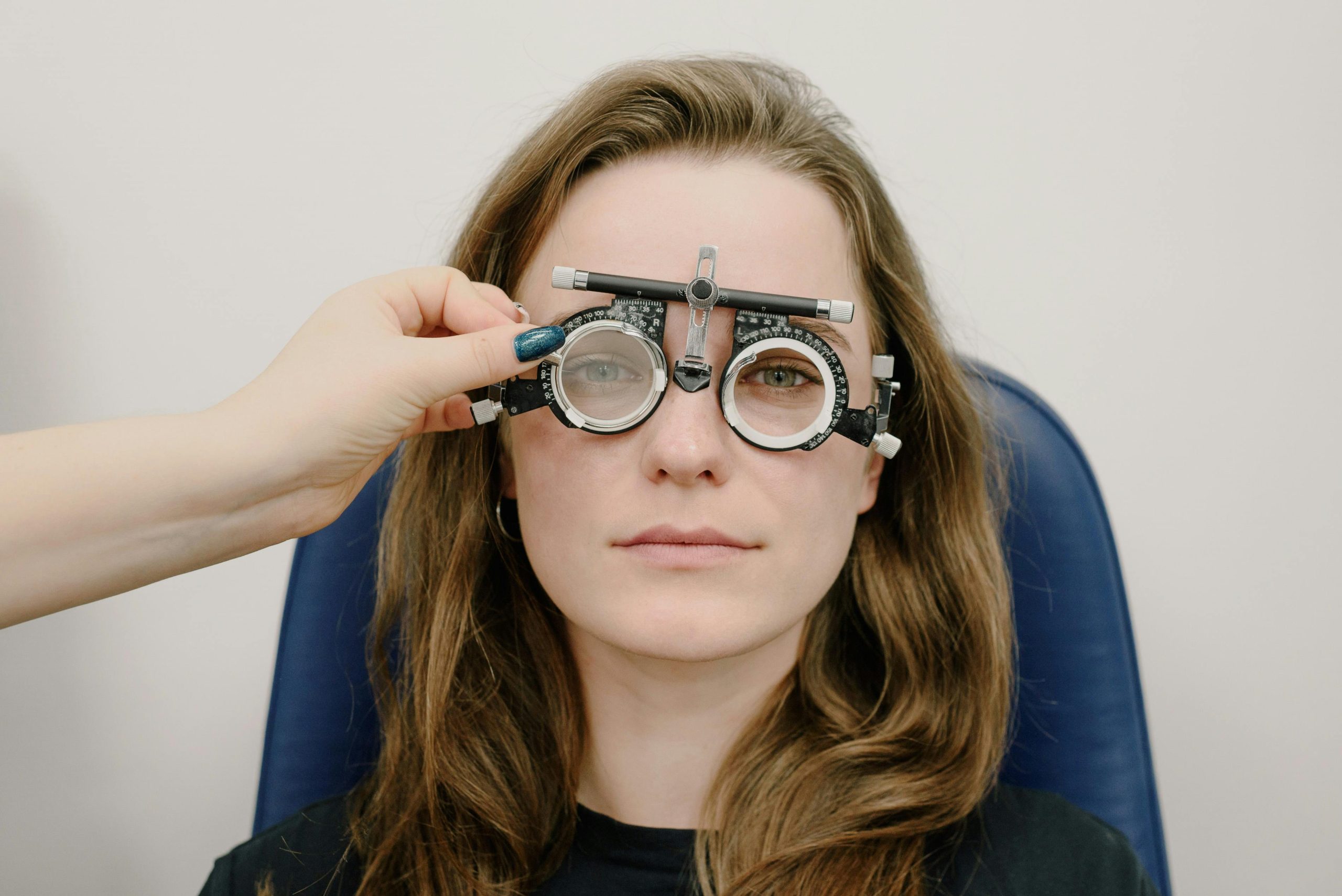
There is an important difference between uncorrected and corrected vision. If you are simply nearsighted or farsighted and have not been examined recently, you might test at 20/200 without glasses, yet see clearly once you put on the right prescription. Legal blindness, on the other hand, refers only to best-corrected vision, the sharpest your eyesight gets even with glasses, contacts, or surgery. This is why an eye exam measuring both uncorrected and corrected acuity matters: it tells your doctor whether the numbers reflect a straightforward refractive error or something needing further evaluation.
What Causes This Level of Vision Loss?
Severe, uncorrected refractive errors are one possible cause, but underlying eye diseases are another. Common conditions linked to significant vision loss include age-related macular degeneration, cataracts, diabetic retinopathy, and glaucoma. Unlike a straightforward prescription for nearsightedness or farsightedness, these conditions affect the health of the eye itself and often need medical or surgical treatment alongside corrective lenses. If vision does not improve with a stronger prescription, an eye doctor will look further to rule out one of these causes.
Impacts on Daily Life
This level of vision affects everyday activities like reading, driving, and recognizing faces from a distance, but it does not mean the world disappears at the 20-foot mark. Objects farther away simply become increasingly blurred rather than invisible. Many people at this level retain meaningful, usable vision, especially up close, which is an important distinction from total blindness.
Low Vision Aids and Adaptations
When glasses, contacts, or surgery cannot fully correct vision, low vision aids can help make the most of remaining eyesight:
- Handheld and Stand Magnifiers: Portable tools for reading mail, labels, or menus.
- Magnifying Reading Glasses: Stronger than standard readers, for close-up tasks.
- Telescopic Lenses: Small mounted lenses for distance tasks like reading signs.
- Video Magnifiers: Also called electronic magnifiers or CCTVs, these use a camera to enlarge text or images on a screen.
Many people use a combination, since each tool serves a different task. A low vision specialist can help determine what fits your needs.
Improving Your Vision
For many refractive causes, prescription glasses or contact lenses remain the first step and can bring vision much closer to normal. Corrective surgery may also be an option in some cases. Talk with your eye doctor about which approach fits your diagnosis and lifestyle.
If you need new glasses, Zenni Optical offers a wide range of affordable, high-quality frames designed to help you see clearly and look great doing it. Browse Zenni eyeglasses and find your next pair today.

FAQs
What Is 20/200 Vision?
It means you must be as close as 20 feet to see what a person with normal vision can see clearly from 200 feet away. It is also the visual acuity threshold most commonly associated with legal blindness in the United States.
Does 20/200 Vision Mean I Am Completely Blind?
No. It describes significantly reduced visual acuity, not total blindness. Most people at this level still have some usable vision, especially for objects that are close by.
Can This Level of Vision Be Corrected?
It depends on the cause. An uncorrected refractive error can often be brought much closer to normal with glasses, contacts, or surgery. If it is best-corrected vision caused by an eye disease, correction may only be partial, and low vision aids can help.
What Is the Difference Between Legally Blind and Totally Blind?
Legal blindness is a specific, best-corrected acuity or visual field threshold used for benefits and services. Total blindness means a complete lack of light perception. Many people who are legally blind retain some functional vision.
How Often Should I Get My Eyes Checked With Low Vision?
Your eye doctor can recommend a schedule based on your condition, but regular comprehensive exams are important for monitoring changes and adjusting treatment.

Dr. Steven Liem
Dr. Steven Liem, O.D., F.A.A.O. is an optometrist based in Pasadena, California. After obtaining his doctorate from UC Berkeley’s School of Optometry, he completed his residency in Pediatrics, Vision Therapy & Rehabilitation and became a Fellow of the American Academy of Optometry. When he isn’t busy streaming or making Youtube videos about video games, Dr. Liem aims to broaden accessibility to vision health through his involvement in optometric industry and tech.




 United States